LOOKS
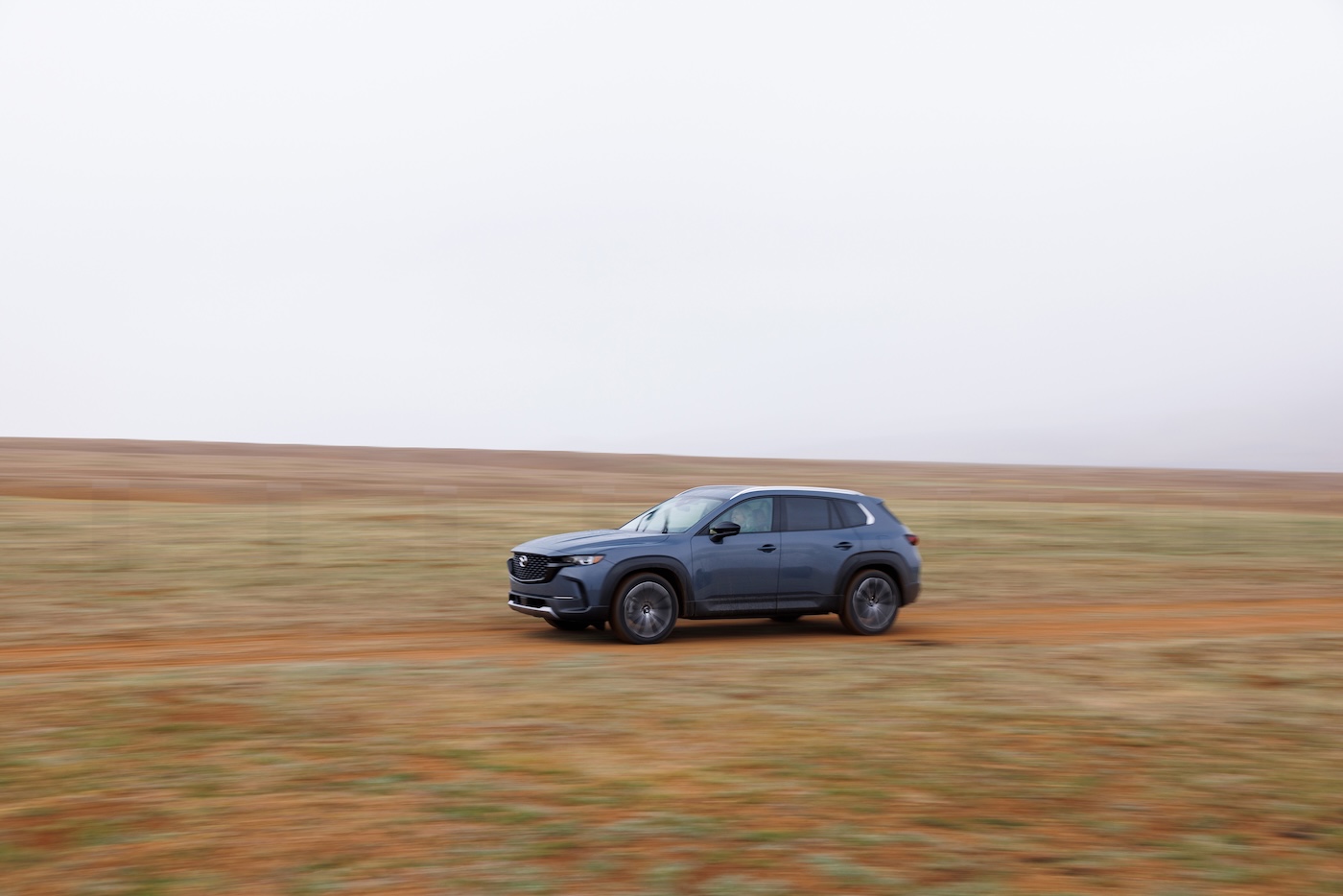
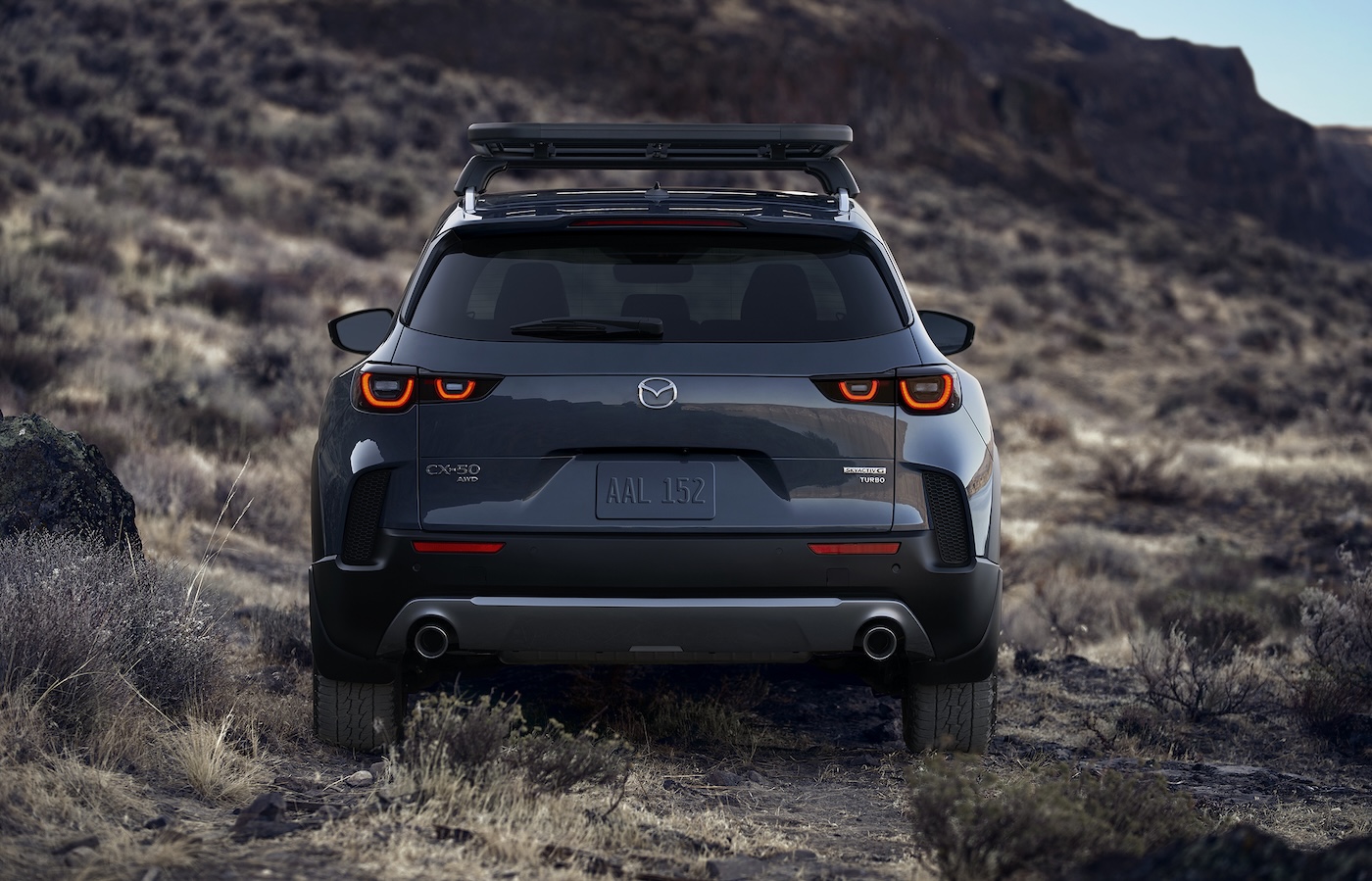
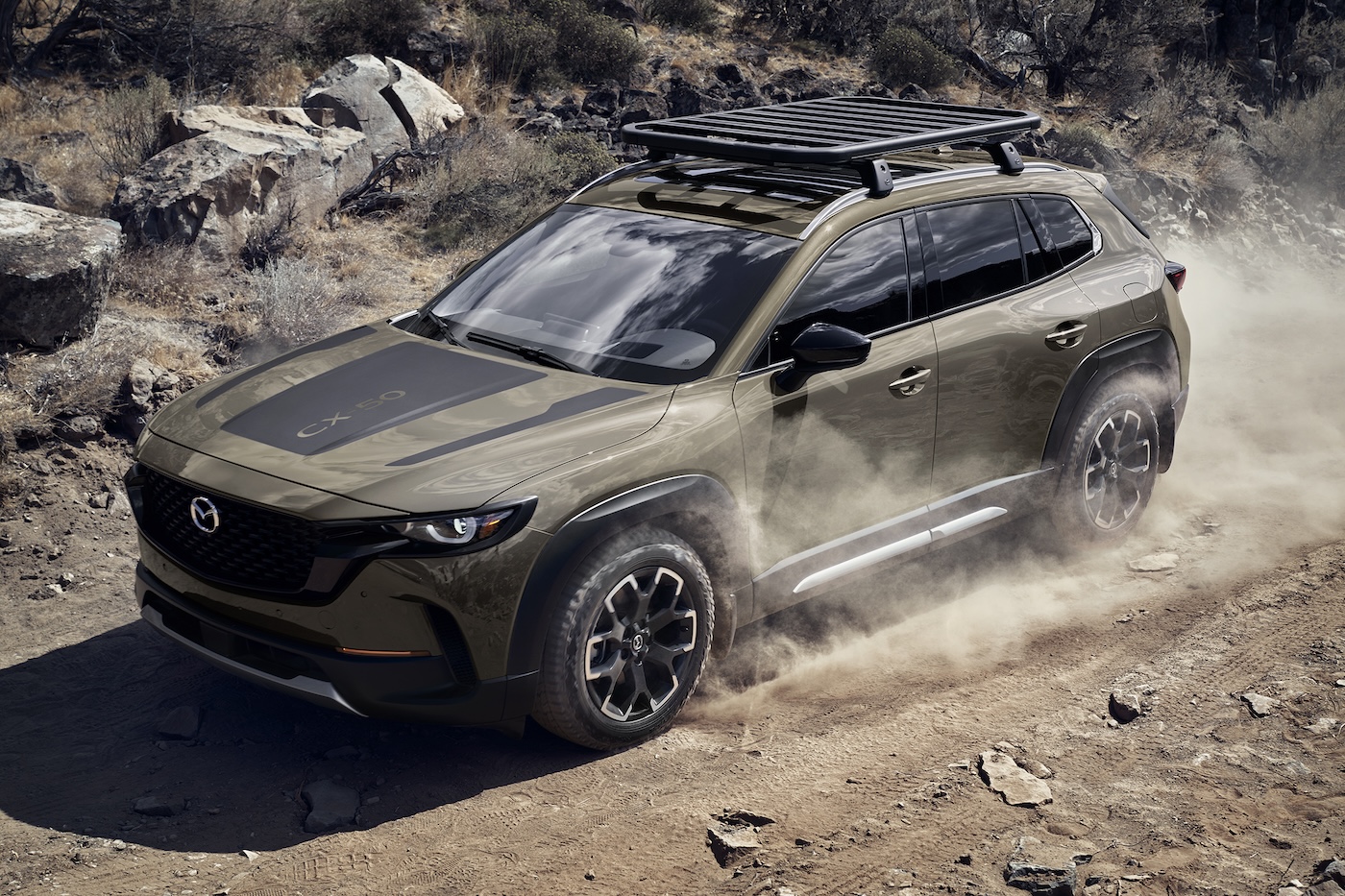
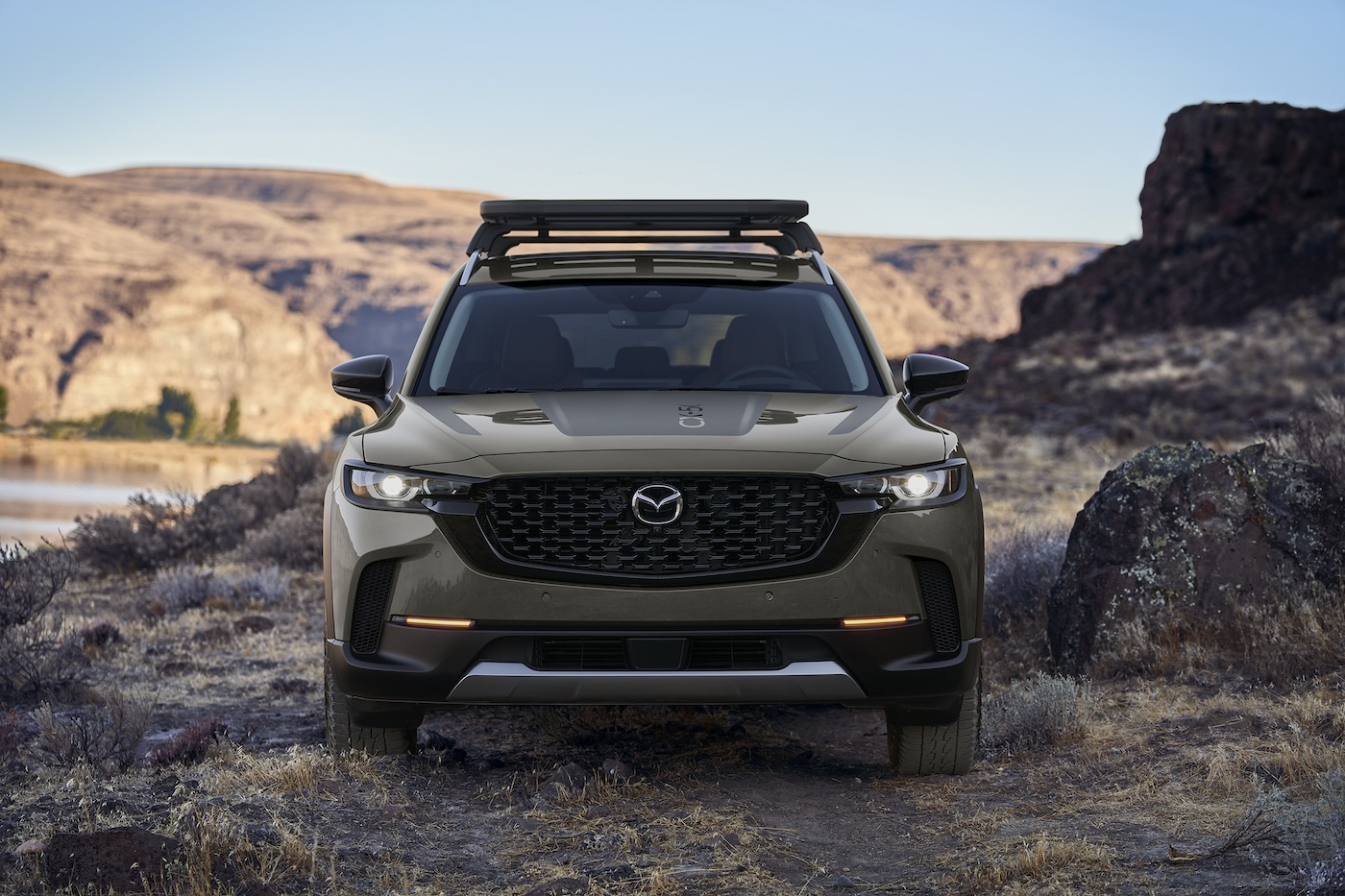
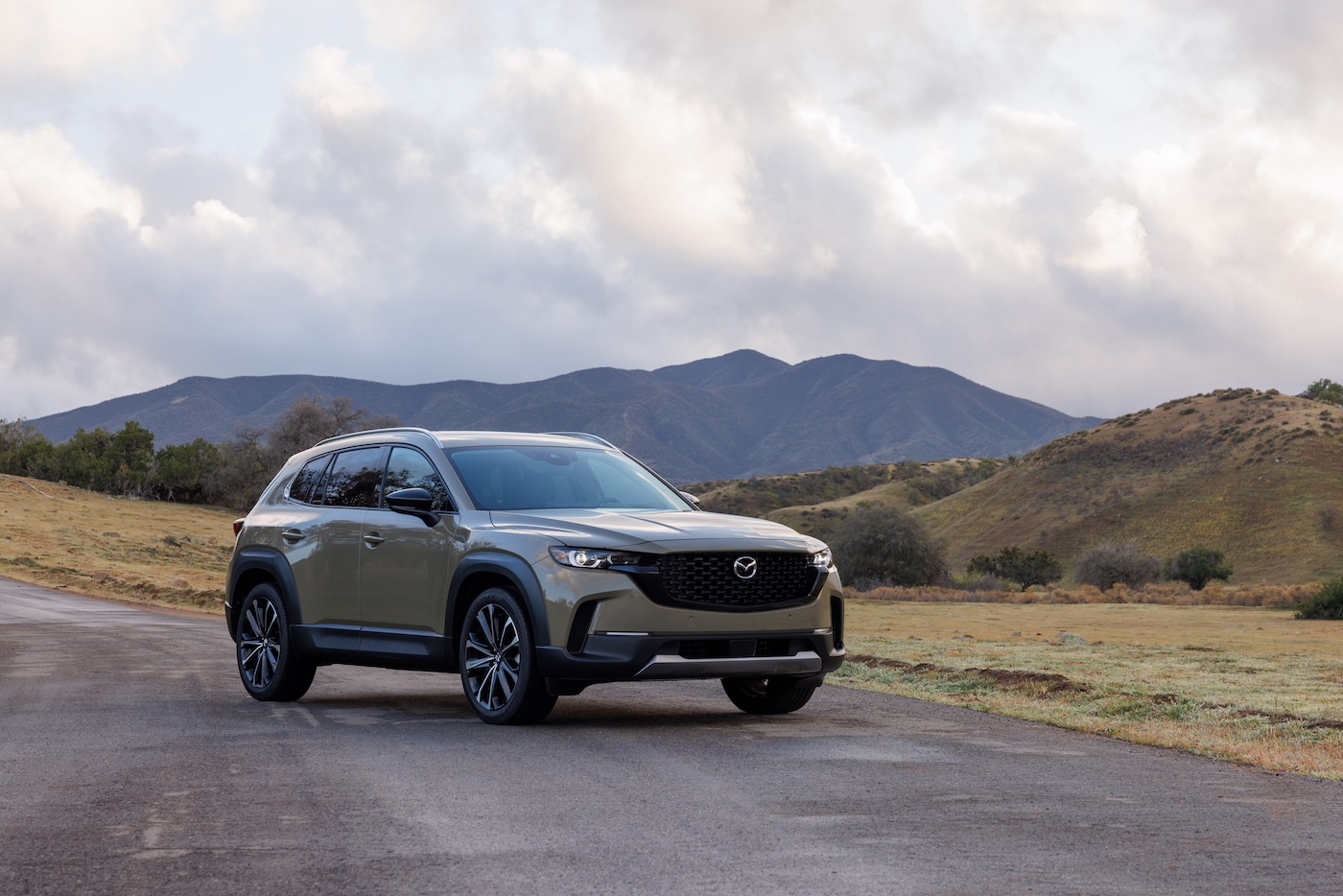
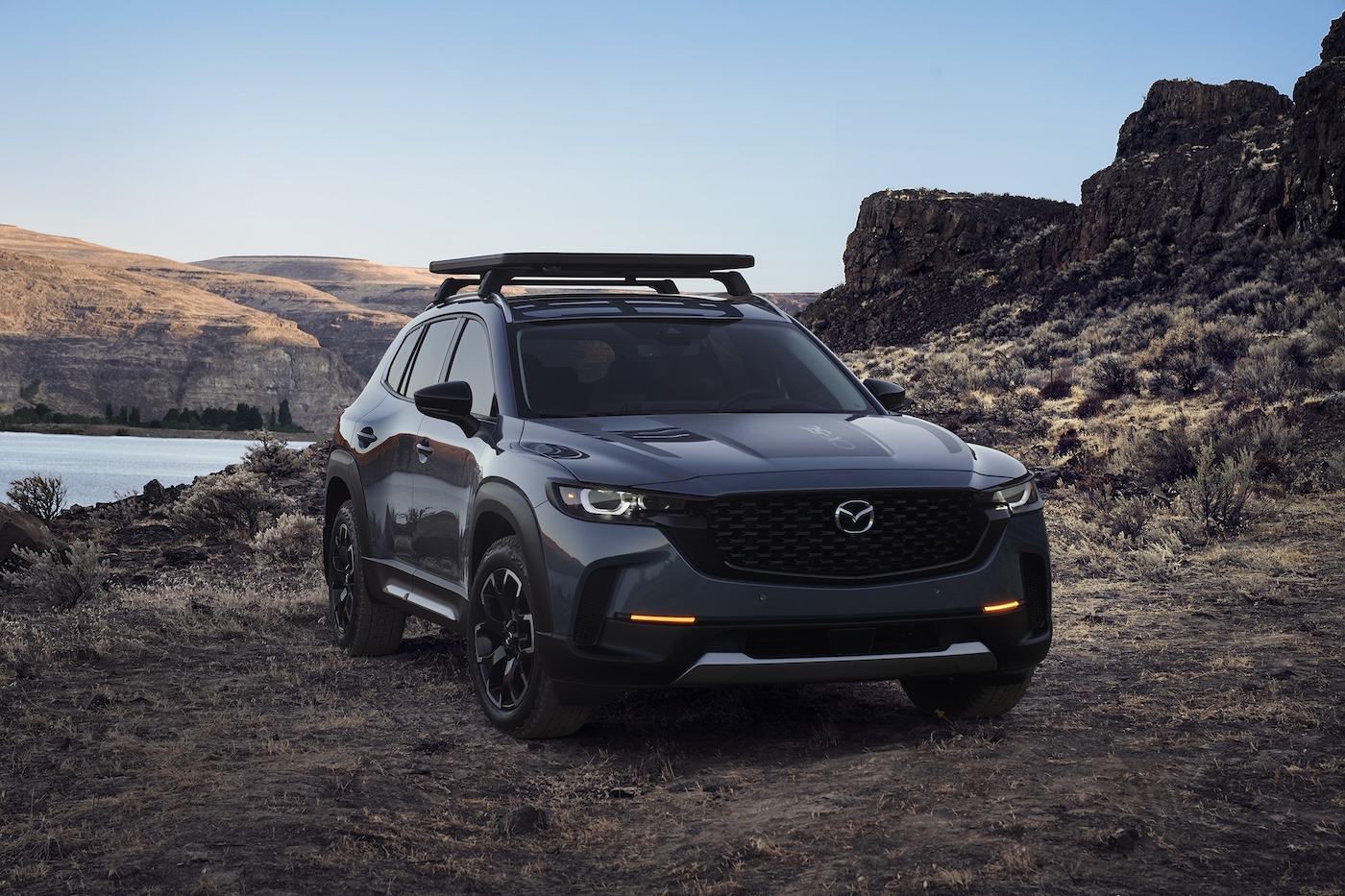
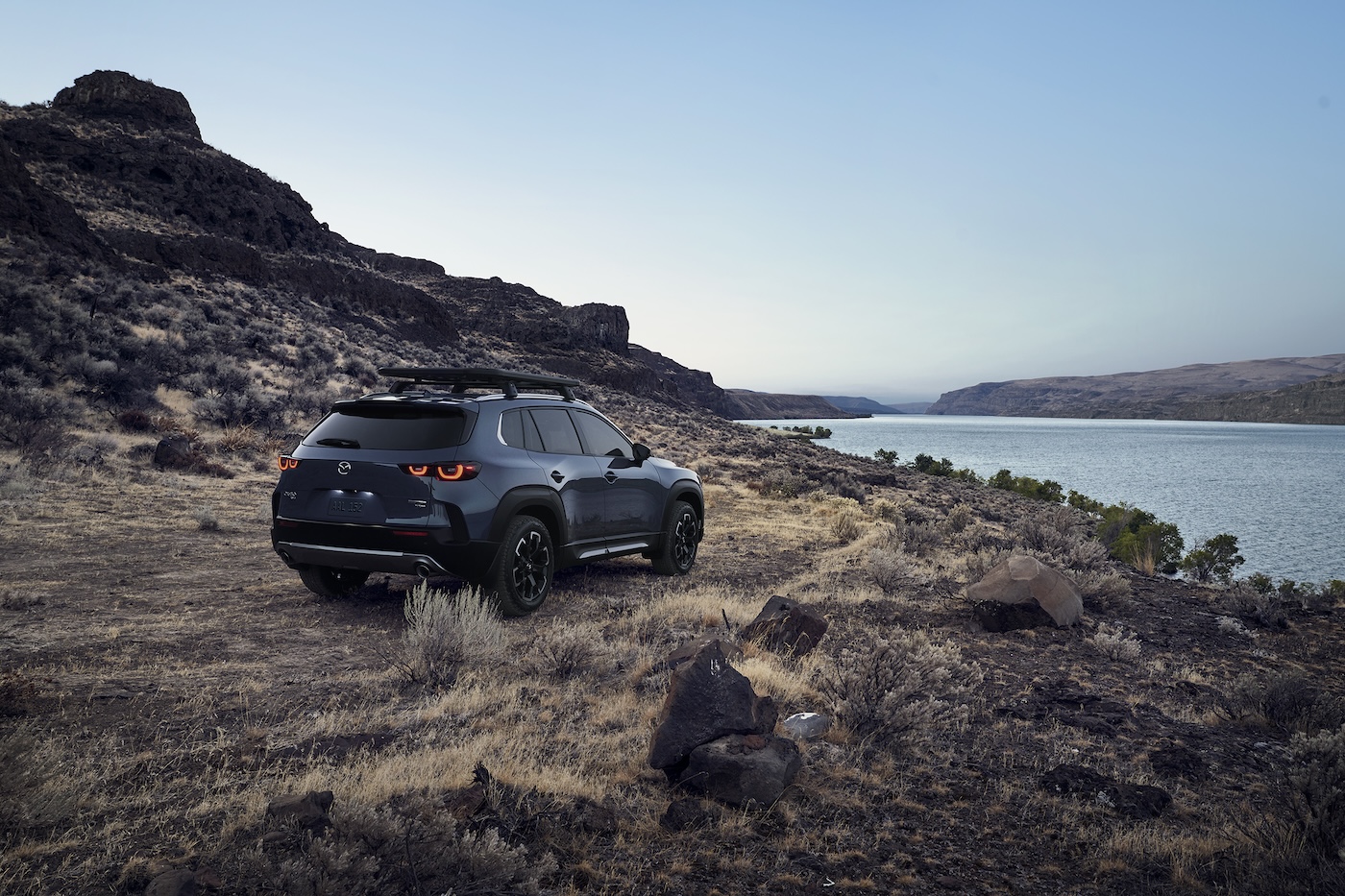
Let’s start out with the exterior design of the CX-50 — which differs from the CX-5 by offering a wider and longer design, a lower roof, and a more rugged design than its counterpart. This one is made to appeal to the adventurer moreso than the grocery-getter.
My test vehicle featured unique hood graphics, and had a very cool Zircon Sand Metallic paint color, one of several special colors offered for an optional fee (such as Polymetal Gray Metallic; Wind Chill Pearl; Machine Gray Metallic; and Mazda’s signature Soul Red Crystal Metallic color).
Other exterior features include:
— Black 18-inch alloy wheels, with 18-inch all-terrain tires
— Rain-sensing windshield wipers, and wiper de-icer
— Roof rails (and an optional roof platform with crossbars)
— Heated, power side mirrors
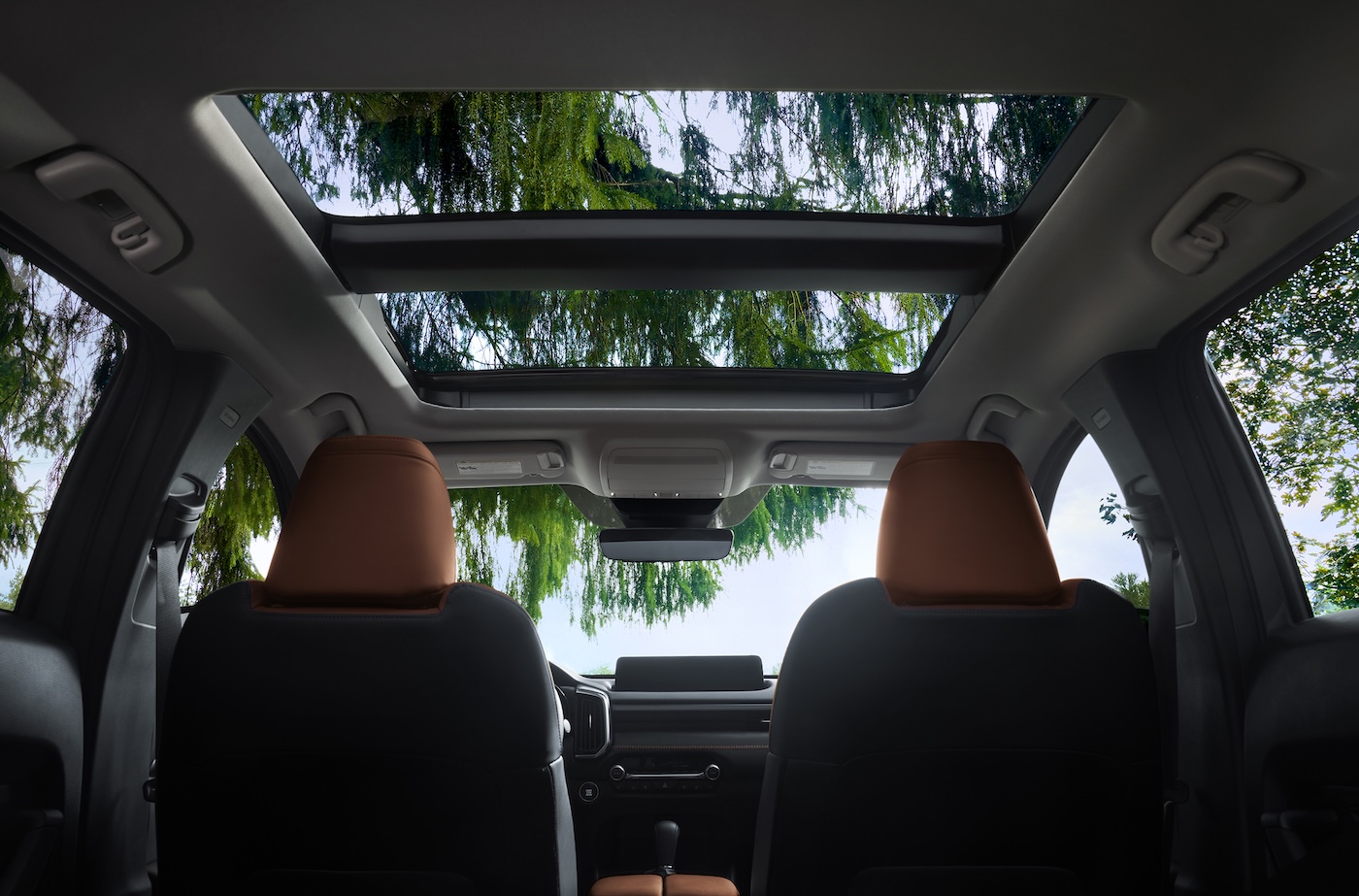
— Power panoramic moonroof
— Automatic LED headlights and adaptive front lighting system
— Power rear liftgate
— Front and rear splash guard
The roof platform allows you to carry gear for your adventures (such as bicycles, kayaks or skis/snowboards) that won’t fit inside a compact vehicle, or large loads from the store.
Overall, it’s a bold-looking and attractive vehicle.
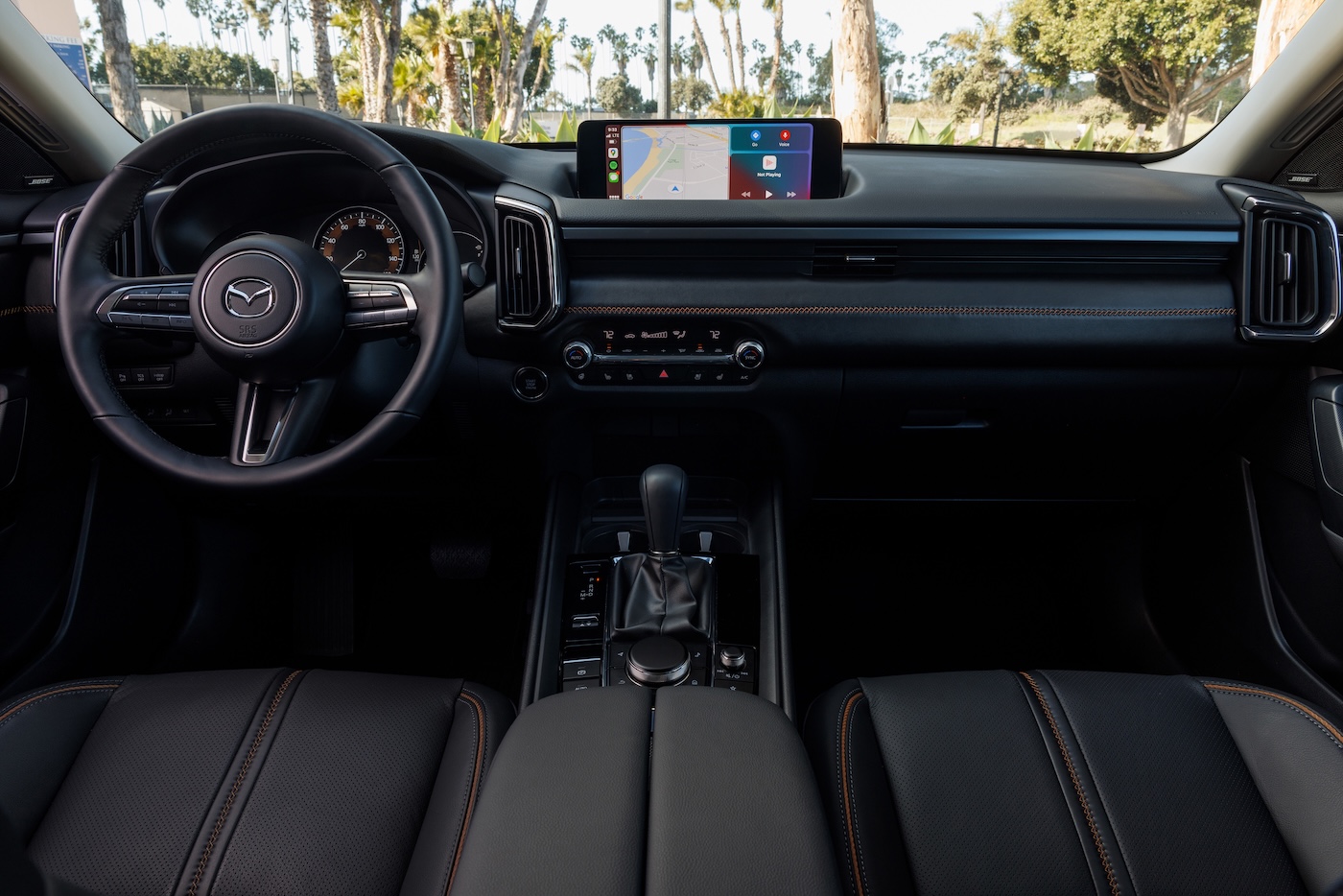
Moving inside the CX-50, you may be surprised at the high quality of the materials used in the vehicle. Mazda is one of the brands in the non-luxury category that doesn’t seem to understand that label, as they continue to provide interiors that would have you confusing the vehicle for a much more expensive brand.
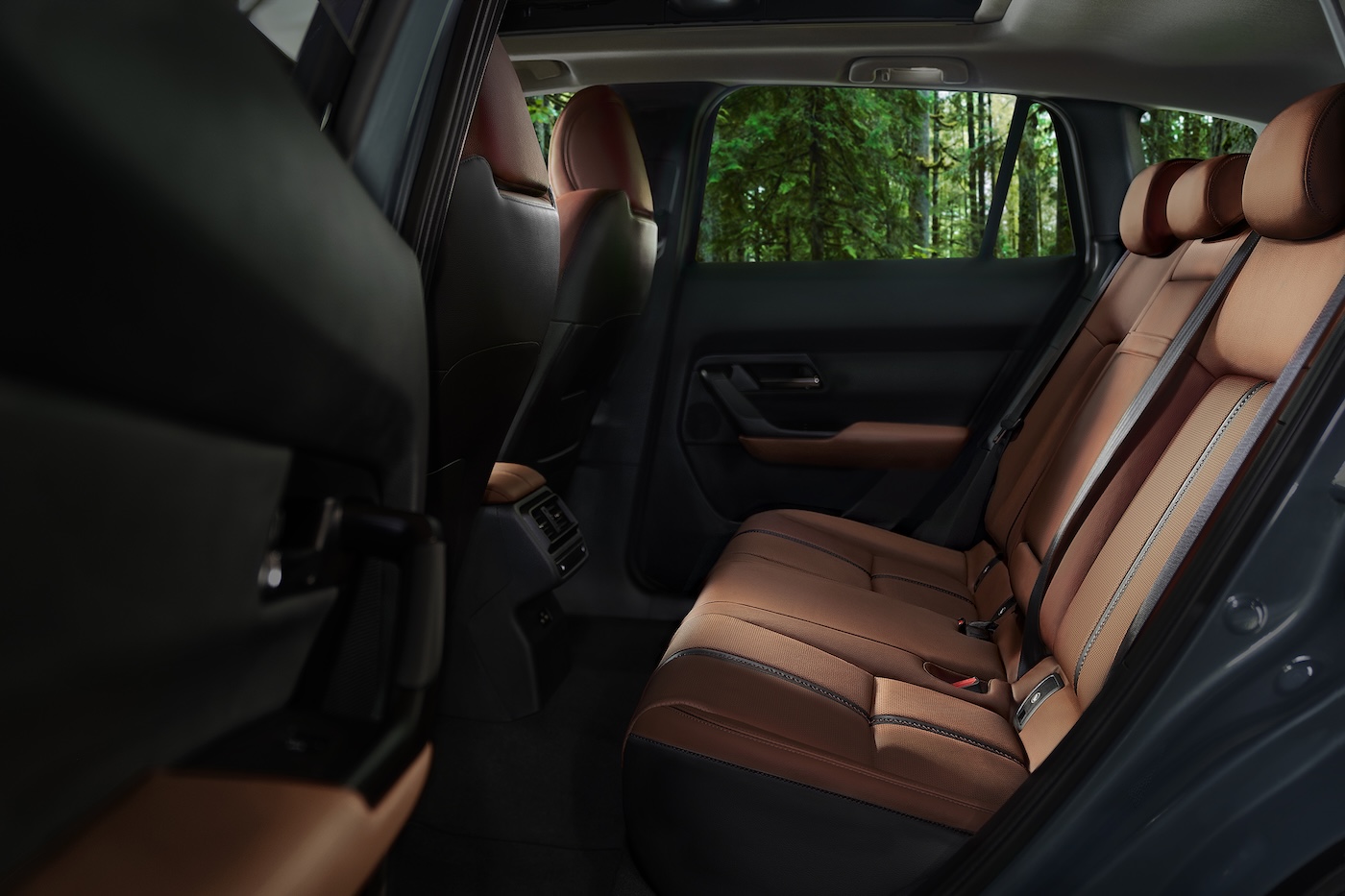
The CX-50 provides seating for 5 people in high-end leather-trimmed seats that are extremely comfortable on long and short drives, and includes heated front and rear seats, ventilated front seats, a heated leader steering wheel, plus dual-zone automatic climate control.
The biggest downside of the CX-50 is the tight space for back seat passengers. As a compact SUV, a bit of tightness is expected, but tall people will be pretty squeezed if they are sitting in the rear of the CX-50, so I recommend it for shorter folks or kids whenever possible. Headroom is also lesser here than in the CX-5.
Cargo space is limited compared to rivals, but thankfully the roof platform is available to allow for storing items on top as well. Numbers come in at 31.4 cubic feet of space behind the second row, and 56.3 cubic feet with rear seats folded down.
HOW’S THE RIDE?
There are three different power plants offered on the 2026 Mazda CX-50 — a base/non-turbo option, a turbo version, and a hybrid option.
I tested the most fun-to-drive engine offering: A turbocharged, 2.5-liter, four-cylinder option delivering up to 256 horsepower and 310 pound-feet of torque (with premium fuel). This is paired with a 6-speed automatic transmission, but paddle shifters are also included if you want to have more control.
The base, non-turbo engine comes in at 187 horsepower, and 185 pound-feet, a noticeable downgrade from the turbo. Drivers looking to maximize power should skip this version if possible.
Acceleration is strong with the turbo engine, with 0-to-60 times in the low 6-second range. The base engine will take longer than 9 seconds.
Finally, a hybrid engine is offered on the CX-50, delivering 219 total horsepower and 163 pound-feet from its gas engine and electric motors. This version will be preferred by buyers who prioritize maximizing fuel mileage over power.
All CX-50 models come with AWD, making it stand out in the segment — as not all competitors do this.
Mazda’s calling card is making vehicles that people who love to drive can truly enjoy when they get behind the wheel every day. And with the turbo engine, this CX-50 delivers that once again, delivering a drive quality that exceeds its compact SUV competitors.
Handling is excellent on roads straight and twisty, acceleration doesn’t disappoint, and it will leave you looking forward to the next drive.
Important to note is that the CX-5, Mazda’s other compact SUV, does not offer the turbo engine on its 2026 model, so that’s going to drive many buyers over the CX-50.
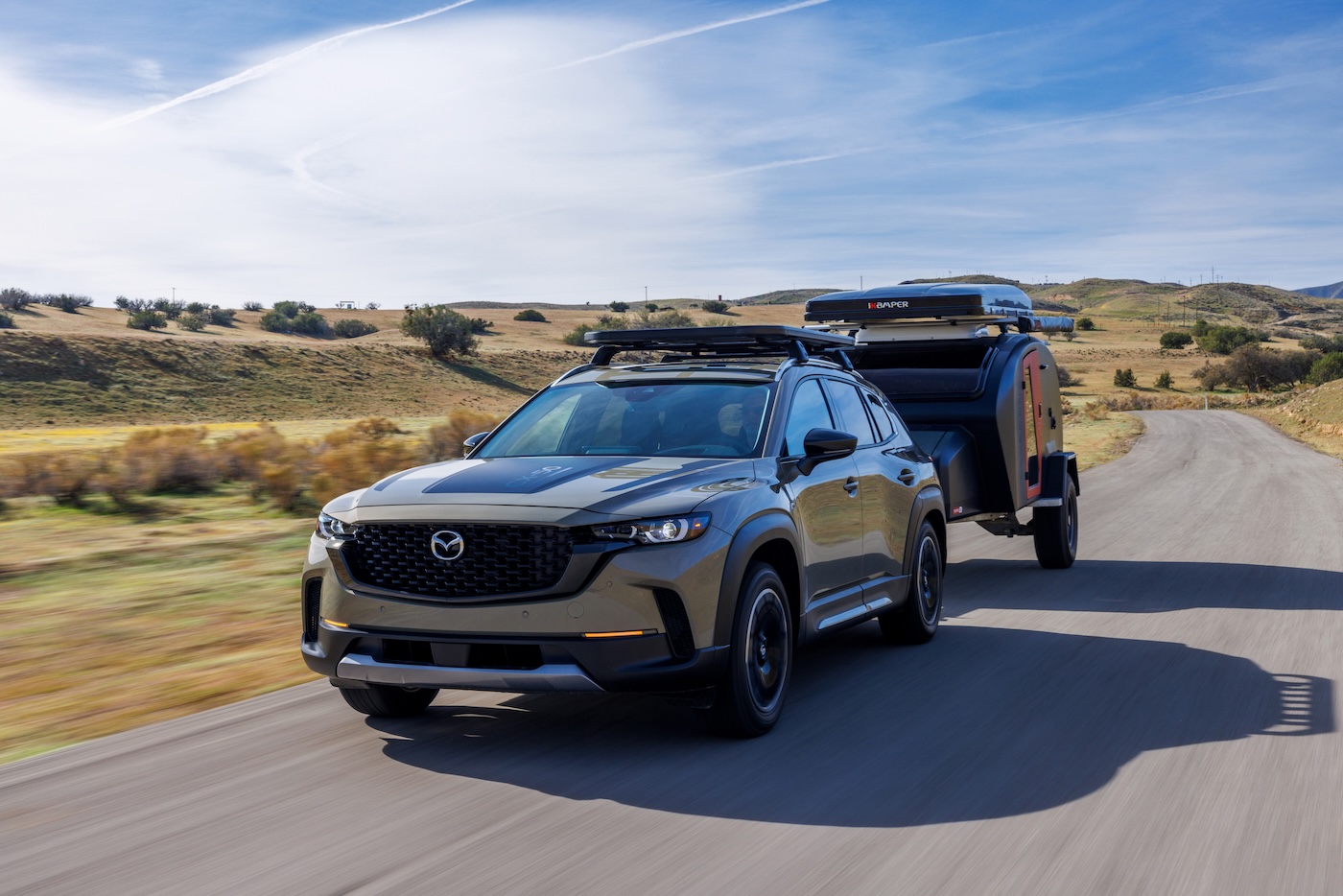
Drive modes include Normal, Sport and Off-Road; and an optional Towing Mode is offered as well.
Sport mode is of course the most fun, but even Normal is quick and enjoyable.
Towing maxes out at 3,500 pounds on the turbo, 2,000 pounds on the nonturbo.
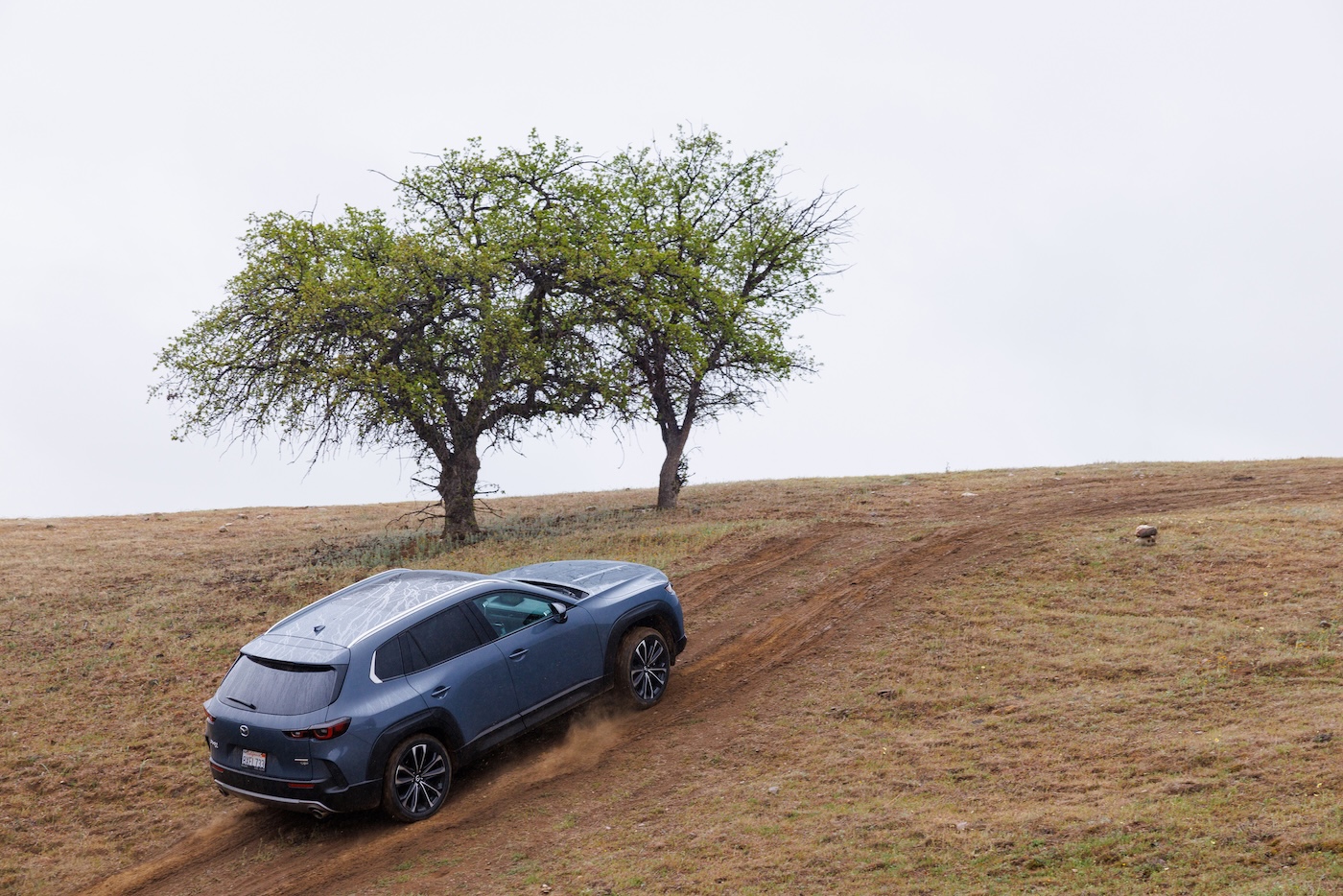
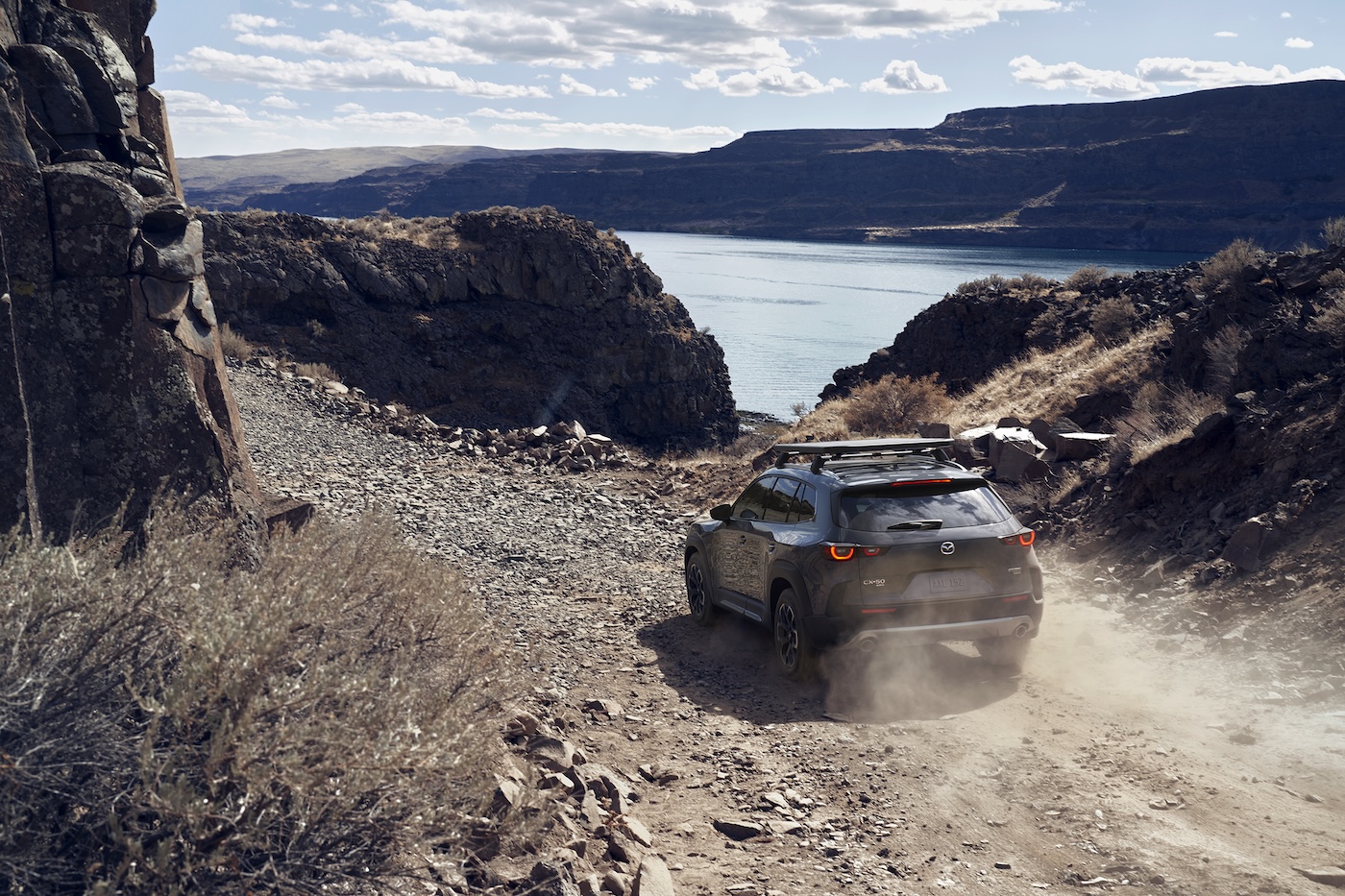
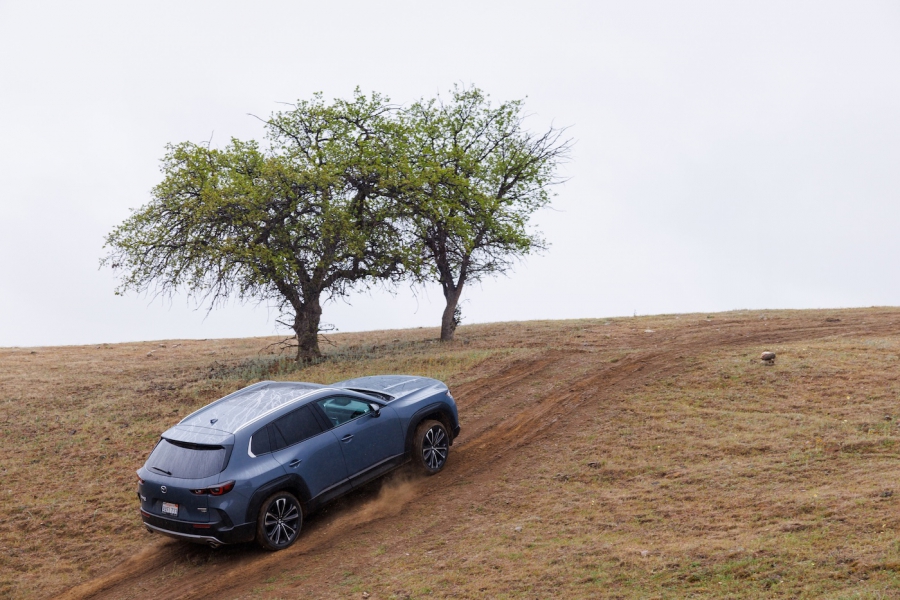
Another enticing aspect is that the CX-50 has some features that make it a bit more off-road friendly.
— There’s the standard AWD system which helps maintain traction on gravel, dirt and snowy roads.
— The Off-Road driving mode also supports smoother rides on uneven terrain.
— Ground clearance is higher to limit impacts to the vehicle’s underside.
Don’t try anything crazy like rock climbs, as this isn’t a true off-roader, but it’s strong enough to handle muddy or gravel/dirt roads, light trails and inclement weather conditions effectively.
TECHNOLOGY, SAFETY
When we’re talking tech, it’s all about the infotainment setup. And the biggest news here is that the 2026 CX-50 retains the old setup focused on a 10.3-inch (non-touch) screen controlled via a center console rotating dial, in contrast to the CX-5, which has upgraded for 2026 to a larger touchscreen setup that is a major improvement.
I’m a bit disappointed the upgrade didn’t make the CX-50, but I’m hopeful that Mazda will bring the upgrade to other models in 2027.
The screen in the CX-50 will only work as a touchscreen when you have connected your phone to the vehicle with wireless Android Auto or Apple CarPlay. Otherwise, the dial must be used, and scrolling through menus without touchscreen ability can be a bit slow and tedious.
Voice commands work well, too, if you’d rather not use the dial for some commands for audio, phone calls, navigation, and more.
In other tech features, the CX-50 features Bluetooth connectivity, sound systems of either 8 speakers (standard) or 12 speakers (optional version with Bose sound), satellite radio, several USB ports, and wireless phone charging.
There is a strong list of safety tech features on the CX-50, especially considering that it’s a smaller SUV. This is reflected in a near-perfect government safety rating.
The CX-50’s rearview and 360-degree cameras are helpful, but they are smaller than the screens offered in the CX-5’s upgraded tech system.
Safety systems in the CX-50 include:
— Front and rear parking sensors
— Automated emergency braking
— Lane Departure Warning System and Lane Keep Assist
— Rear Cross Traffic Alert
— Blind Spot Monitoring
— Advanced dual front airbags, front side-impact airbags, front and rear side air curtains, front knee air bags
— Mazda Radar Cruise Control
— Traffic Sign Recognition
— Vehicle Exit Warning
— Driver Attention Alert
All of these systems work well without being overly intrusive, and it’s a comfort to know they’ll step in should a situation emerge where they are needed.
MPG
The official fuel mileage numbers on the 2026 Mazda CX-50 I tested (with the turbo engine) were 23 city/29 highway/25 combined. In real-world driving, I averaged a few miles per gallon less than the listed numbers.
The non-turbo engine in the CX-50 slightly bumps up official numbers to 24 city/30 highway/26 combined.
These are not stellar numbers compared to rivals in the segment, but the reality is that the CX-50’s drive quality is much better, so you’ll need to decide whether performance or fuel mileage is more important to you when cross-shopping in this segment.
And if you like Mazda but want better fuel mileage numbers, you should opt for the CX-50 hybrid, which is listed at 39 city/37 highway/38 combined.
PRICE
The 2026 Mazda CX-50 that I tested was near the top of the price range, coming in at $44,675 including option. Base price starts about $30K, and you can get a solid vehicle with strong features in the mid-$30K range.
Trim levels include Select, Preferred, Meridian Edition, Premium, Turbo, Turbo Meridian Edition, and Turbo Premium Plus. With that wide a range, there are options to fit most budgets.
Separately, the hybrid version of the CX-50 is priced between $35K and $40K.
These prices are generally competitive in the compact SUV segment, though once you reach the higher trims they can start to feel a bit high and may give some buyers pause — though those concerns may be eased by the abundance of features included, plus the standard all-wheel drive.
Also of note, the CX-50 is built at a plant in Alabama as part of a partnership between Mazda and Toyota, and 65 percent of parts used in the vehicle are from the U.S. and Canada, blurring the lines of what some may consider an American car.
Warranties on the CX-50 are decent, but not the best available.
You get the following:
— 3-year/36,000 mile overall new vehicle warranty
— 5-year/60,000 mile powertrain warranty
— 3 years/36,000 miles of roadside assistance
However, there is no complimentary maintenance included.
BOTTOM LINE
The 2026 Mazda CX-50 is an excellent fit for Mazda fans who like the design and upscale nature of the brand, but want a compact SUV that’s a bit more off-road and adventure friendly than the CX-5.
Also of note, it's currently the only compact SUV from Mazda featuring the turbo engine in 2026, which will also be a big draw.
Compared to key rivals like the Honda CR-V and Toyota RAV4, the CX-59 is both better looking and more enjoyable to drive.
===
AutoTechReviews.com can be found on Twitter @AutoTechReview, or stay updated at the AutoTechReviews Facebook page. Follow AutoTechReviews on Instagram at @Autotechreviews or on TikTok at @AutoTechReviews.. Matt Myftiu can be found on Twitter @MattMyftiu.