
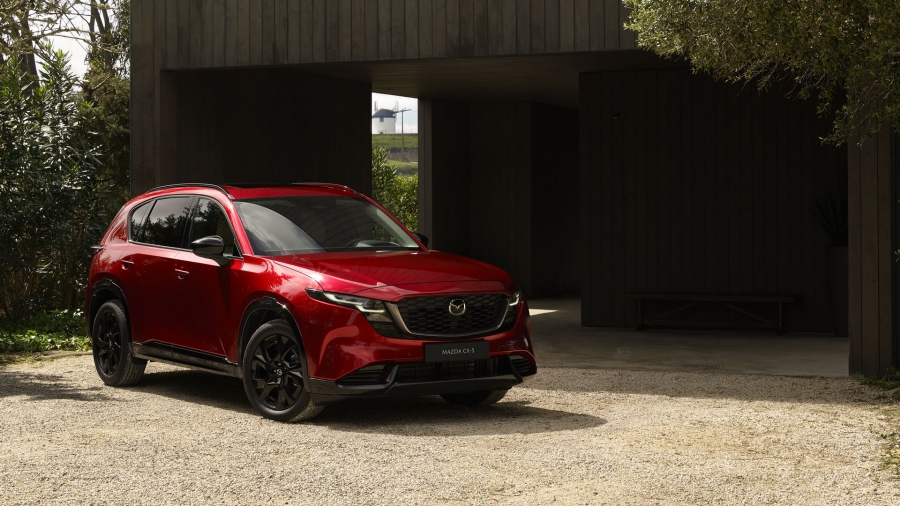
1. Upscale design, size will grow in 2026
One thing that Mazda has done in recent years is deliver a design that approaches luxury quality despite not being a luxury brand. Especially on the interiors, materials are of a quality that makes you feel like you’re in a much more expensive and upscale ride.
As the 2025 model year ends and the model prepares to launch in 2026, one change that we know is coming is that the CX-5 will be getting a bit longer, specifically gaining 4.5 inches in length. That’s a welcome bit of news, as any extra length is beneficial in the class of compact SUVs, where leg room is often hard to find in the back row. The current model is not super-tight, but I’ll always appreciate more space. And cargo space should also improve in 2026 due to the vehicle’s larger size.
Other exterior changes expected for 2026 include a 3-inch larger wheelbase, and an overall styling update that will draw inspiration from the looks of the larger CX-70 and CX-90 SUVs. Changes are coming to the lighting design, grille design and more. I was always a fan of the current generation of CX-5, but the updates promise an even sleeker and more stylish vehicle.
Whether you choose a 2025 or wait for the changes in 2026, you’ll be getting a vehicle that’s pleasing to the eye. And if you want for 2026, you’ll have a roomier interior.
2. Engaging drive quality
If you’re a person who loves to drive, you’re going to love driving Mazdas, and there’s a good reason for that, as they make their vehicles with performance in mind.
A truly enjoyable drive quality and strong engine options, quick 0-to-60 times, agility and strong handling have long been the top attraction for Mazda buyers and makes the brand stand out over most rivals.
There are two engine options on the 2025 model — a base engine delivering 187 horsepower and 185 pound-feet of torque, or a turbo engine that offers 256 horses and 320 pound-feet when premium fuel is used.
It should go without saying that if you have a choice between the two engine options, choose the turbo, which offers one of the best overall driving experiences you’ll find in the compact SUV segment — many levels better than top sellers like the Honda CR-V or Toyota RAV4.
For 2026 models, it’s still to be determined if the turbo engine will carry over, but I think Mazda would be crazy not to offer it, as it wouldn’t make sense to only offer the base engine after people got used to this level of power. Like the 2025 offerings, all 2026 models are expected to be AWD, and tweaks are expected to improve the already-impressive driving experience.
Looking further ahead to 2027, a hybrid powertrain is being developed, which will add another dimension to the CX-5’s power plant options and may draw in more eco-friendly buyers into the fold.
The 2025 model features paddle shifters if you want to have more control over the gears, and Sport mode can be engaged to boost your fun level. There’s also an Off-Road mode, Hill Launch Assist, front and rear stabilizer bars, Dynamic Stability Control, and Traction Control System.
Zero-to-60 times with the turbo engine come in the low 6-second range, which is leagues better than most rival compact SUVs. With the base engine, you’re closer to 8 seconds, which is a similar speed to most rivals.
3. Tech setup struggles, but improvements coming in 2026
The tech/infotainment setup is an area where I’ve long wanted some change in the Mazda lineup.
Controlled for the past several years primarily through a center dial (instead of the usual touchscreens you see on most rivals), I tend to find this system requires more work than it should to manipulate, and is less intuitive and user-friendly than most rival systems.
Looking ahead to next year, the good news is that Mazda has finally recognized the shortcomings of its current setup in the CX-5, and will implement a large Google-based touchscreen setup for the upcoming 2026 model. The 2026 lineup will offer a standard 12.9-inch touchscreen, with the option for a larger 15.6-inch screen, a major increase in size from the current 10.25-inch screen.
Google features such as Google Maps for navigation, and Google Gemini AI Assistant, will be incorporated into the new system, and the center dial/knob will disappear.
I’m looking forward to the change, and with the 2026 model debut coming very shortly, anyone who’s unhappy with the current design of the tech systems won’t have long to wait.
On the other hand, if you’re not a huge fan of large touchscreens, and prefer the current Mazda setup, you’ll likely be able to get a deal on a 2025 model. It’s also worth noting that when you connect your phone via Android Auto or Apple CarPlay, you can use the touchscreen on a 2025 model.
Other tech features of note in the CX-5 include:
— Bose 10-speaker sound system
— AM/FM/HD radio
— Bluetooth connectivity for phone call and audio streaming
— 3-month trial of satellite radio
— 4 USB ports (2 in front, 2 in rear)
— Mazda Connected Services
4. Average fuel mileage
Fuel mileage is one area where the CX-5 is respectable, but lags behind some competitors.
Official fuel mileage numbers on the CX-5 with the turbo engine are listed at 22 city/27 highway/24 combined miles per gallon. And the base, non-turbo engine is listed at 23 city/29 highway/25 combined mpg. I found the numbers to be mostly accurate during my time driving the 2025 CX-5.
By comparison, some rival SUVs in the segment can reach as high as 30 mpg combined, a significant difference. Keep in mind though, that part of the reason for the difference is the improved performance of the CX-5 over key rivals.
And if you want to go even further, many hybrids are offered in this segment, but thankfully that is in the cards for Mazda in a couple years so they can better find buyers seeking eco-friendly options. And it’s possible Mazda will find a way to secure fuel economy improvements on the ICE engines for 2026.
5. Competitive pricing
Pricing on the 2025 Mazda CX-5 starts around $30K for base model and tops out around $42K. For 2026, numbers have not been announced yet, but pricing should be similar.
These numbers are mostly in line with its rival compact SUVs, and a bit more expensive than some alternatives. But it’s important to recognize that the CX-5’s design and performance beats most of its rivals, making that slight price difference justified, especially on versions with the turbo engine.
Trim levels on the CX-5 include S, Select, Preferred, Carbon Edition, Premium Plus, Carbon Turbo, Turbo Premium, and Turbo Signature. This means there is something available for a wide variety of budgets, and some of the lower trims still deliver a solid experience in the CX-5.
Warranties and good, but not the industry-best. You will get a 3-year/36,000 mile new vehicle warranty, and a 5-year/60,000 mile powertrain warranty, but no complimentary maintenance included.
===
AutoTechReviews.com can be found on Twitter @AutoTechReview, or stay updated at the AutoTechReviews Facebook page. Follow AutoTechReviews on Instagram at @Autotechreviews or on TikTok at @AutoTechReviews.. Matt Myftiu can be found on Twitter @MattMyftiu.